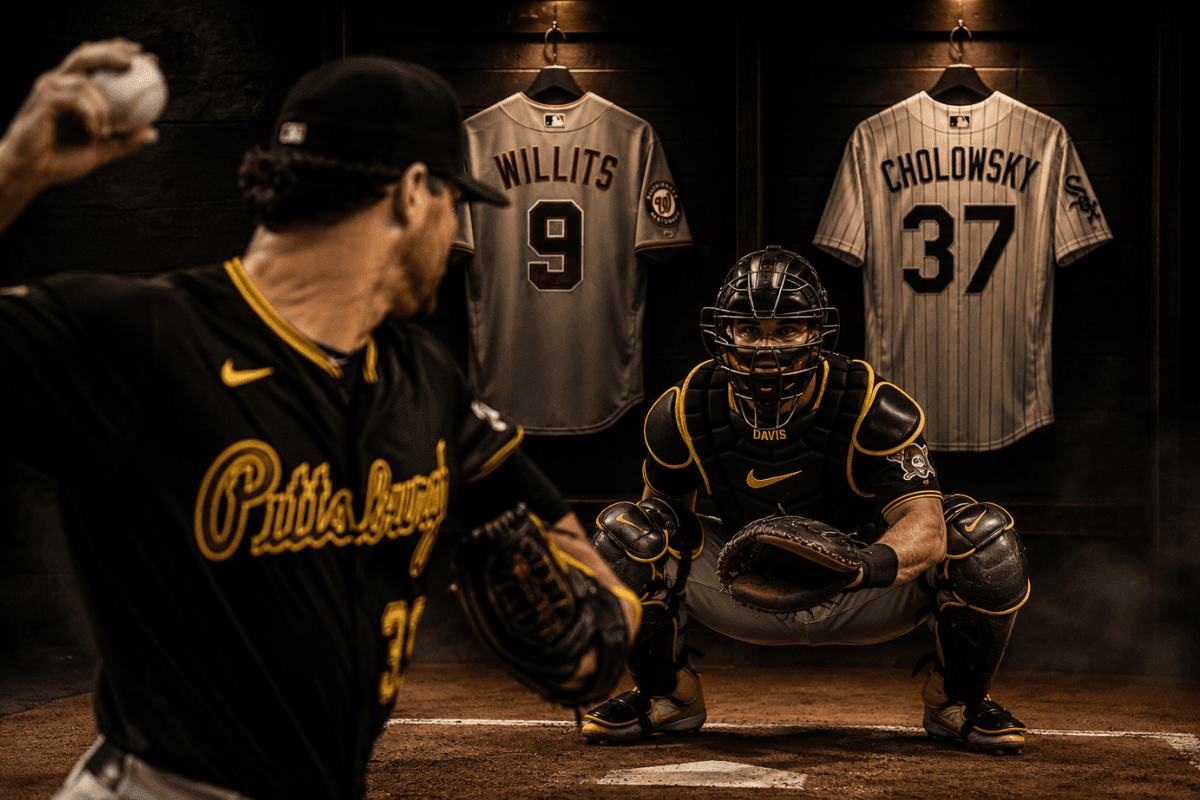
With the Pittsburgh skyline framing the scene for the influx of talent that Pirates fans have been waiting five decades for, the formula seemed to make perfect sense.
Henry Davis, a power hitting catcher dubbed a generational talent and taken number one out of the University of Louisville in the 2021 draft, would provide the battery for a super talented, homegrown rotation. The rotation, led by Paul Skenes, the 2023 number one pick, took MLB by storm in short order. Skenes won the National League Rookie of the Year award in 2024, following it up with a unanimous Cy Young Award in 2025.
The Bucs have held a top ten pick in each of the past seven consecutive MLB drafts, with four, including Davis and Skenes, being selected within the top five.
The dream, though, of a Skenes-Davis battery, accompanied by a potentially stacked rotation of Pirates pitchers who quickly made their way to MLB, is increasingly fading into obscurity.
No Talent Shortage
There is plenty of talent. Some have experienced bad luck, including early Rookie of the Year candidate Konnor Griffin, the ninth overall pick in 2024, who is currently on the 60 day injured list. Others have underperformed, such as power hitting middle infielder Termarr Johnson, the fourth overall pick in 2022, who is also sidelined with a torn ACL.
Unlike any other major sport, the MLB draft is about as far from a guarantee of success as one could imagine.
According to a historical review conducted by MLB in late 2024, just nine of the 60 first overall picks going back to 1965 could be deemed truly impactful, franchise altering, or the best player available. Those are all of the tags that organizations place on their guy when they make the selection.
That is an enormous expectation for one player in a team game and a system based sport that is malleable and requires constant adjustments.
“The No. 1 overall pick in the draft is supposed to be the no brainer. Those taken first overall are the ones slated not just for a big league career, but for superstardom,” wrote MLB.com’s Andrew Simon.
Yet the start of the 2026 season saw three clubs with two recent number one overall picks in their starting lineups who, for whatever reason, had failed to produce or compete for anything meaningful.
Multiple 1-1's
The Detroit Tigers dealt their 2018 first overall pick, pitcher Casey Mize, to San Diego for a handful of prospects. The 2020 number one overall pick, Spencer Torkelson, has enjoyed some moderate success in the home run department, but has yet to become the perennial All Star the Tigers anticipated him becoming.
Baltimore, like Pittsburgh, has had success flooding the organization with top prospects and ultimately filling its starting lineup with mostly homegrown talent.
At the top level, the system worked well, with the Orioles winning an impressive 101 games and a division title in 2023, followed by a Wild Card appearance in 2024. Despite being knocked out early in each of their recent playoff appearances, the young core of Orioles players generated excitement among the fanbase and praise from ownership.
Now in 2026, the landscape has shifted slightly, with Baltimore turning to free agency to boost its efforts, particularly in October.
The Orioles dealt their 2019 first overall pick, three-time All Star catcher Adley Rutschman, and are appearing patient in allowing 22 year old and 2022 number one overall pick Jackson Holliday to continue his development at the MLB level.
Currently with an average hovering around .230 and an OPS in the mid .600's, Holliday will need a substantial offensive boost over the remainder of the season, as well as a strong 2027 season, for the Orioles brass to avoid eventually shopping him around to the lowest bidder.
The Pirates remain the last team standing with two number one overall picks on the current roster.
How long Davis can hang onto the role of starting or even backup catcher in Pittsburgh is more than likely a conversation being had behind closed doors as the Pirates slip mathematically out of Wild Card contention for 2026.
With catching depth in the form of Endy Rodriguez, a switch hitter, and Rafael Flores Jr., another potential power hitter who has impressed in a relatively small sample size this season, the heat is on for Davis to play closer to his billed potential.
Unlike the NBA, where, for example, the Dallas Mavericks currently have three former number one overall picks on the floor, all of whom can change the trajectory of a franchise, or the NHL, where a swift skating teenager can substantially change the offensive output of a team straight out of training camp, the MLB draft does not predict a team’s future success in quite the same way.
The NFL is perhaps the clearest example. A team can address a need for the next five to ten years by drafting the right player.
In MLB, that certainty simply does not exist.
In many cases, as mentioned, the player might develop into a major league contributor, but with another team.
Other than Skenes, the last true star player to have an impact both individually and in altering the course of a franchise came in four consecutive years, from 2009 through 2012, when Stephen Strasburg, Bryce Harper, Gerrit Cole and Carlos Correa were selected number one overall in corresponding years.
Their impact, in every case, is undeniable, and their selections are a testament to the scouting departments of each club.
Each was clearly dubbed a generational talent when his name was called.
Moving forward, some exciting number one overall picks are already tearing it up in the systems of the organizations that selected them.
Willits Living Up To The Hype
Shortstop Eli Willits (2025 #1) will have plenty of time to develop, now that shortstop CJ Abrams has become one of the best players in the game and is under the control of the Washington Nationals organization until after the 2028 season.
The same will be true of this year’s number one overall pick, Roch Cholowski, who has stumbled slightly out of the gate in the Chicago White Sox system since being signed. But the ChiSox, who are sitting first in the American League Central, are yet to express concern.
Commissioner Rob Manfred has proposed some amendments to the MLB draft format. The changes are huge, and who knows if there will even be a place at the table of negotiations for them to be raised this year.
Several heavily contested items will come before draft revisions.
If players were required to play college baseball for, say, a minimum of two years, as proposed, that would improve players’ readiness for professional baseball and, in effect, raise the level of professionalism across all systems.
College baseball would be incredibly captivating, with top prospects playing in both two year and four year colleges, while professional baseball would be filled with players who bring a new level of readiness.
Perhaps that is the future MLB needs.
When a team calls a player’s name first overall, everyone expects him to change everything.
The reality is that very few actually do.
Sharp takes. Every morning.
Get the day's top stories, line moves, and exclusive analysis.
Join sharp bettors getting daily insights. Unsubscribe anytime.
BOOST US IN GOOGLE
★ Get more Cover takes in your Google Search