
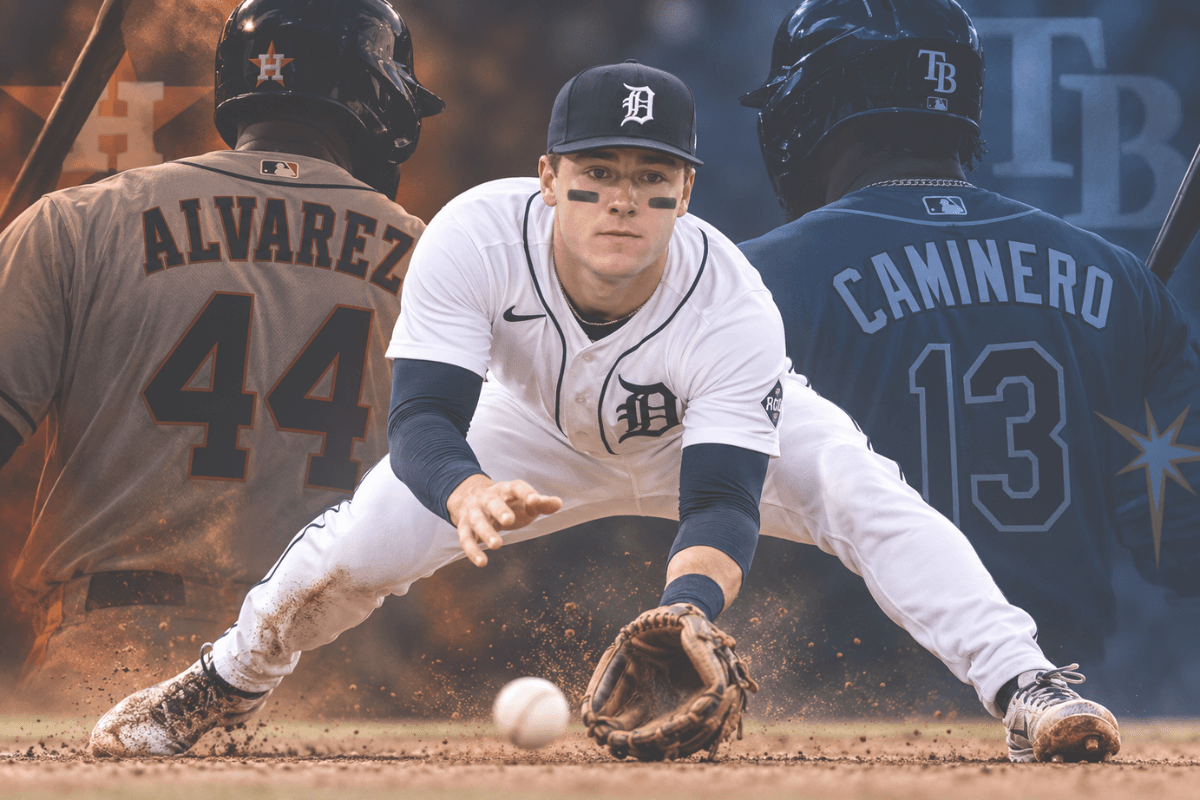
Detroit Tigers infielder Kevin McGonigle, along with Cincinnati Reds first baseman Sal Stewart, have emerged as the clear favourites to be awarded Rookie of the Year in the American and National Leagues, respectively.
In another season in which the rookie class in both leagues has once again been stellar, the two MLB freshmen, who were also first-time All-Stars, have emerged as the most likely candidates to be added to the recent list of ROY recipients who are now commonly known as some of the best players in the sport. Impact players such as Baltimore Orioles shortstop Gunnar Henderson (2023 AL ROY), Julio Rodríguez (2022 AL ROY), Paul Skenes (2024 NL ROY) and Corbin Carroll (2023 NL ROY) were definitely not one-hit wonders, in any sense.
These are just a few examples where the BBWAA hit the sweet spot, by identifying young players who were not only exceptional rookies, but legitimate stars in the making. Looking back further across the modern analytics era, where categories such as OPS, WAR and eventually the explosion of Statcast data became the metrics for determining player value, the list Rookie of the Year recipients starts to resemble an exclusive, future Hall of Fame gala.
Aaron Judge won the 2017 AL ROY. Yordan Alvarez won it in 2019. Shohei Ohtani won the award in the American League in 2018, while Ronald Acuña Jr. took home the NL award that same year. Corey Seager won the NL ROY in 2016.
The list goes on.
Before this era of Baseball Savant, Statcast and increasingly sophisticated player evaluation, several names fell into the vaults of baseball trivia. Recently though, say within the past 15 years, with maybe one or two exceptions, the Rookie of the Year winners have tended to become exactly what the award suggested they might become: elite MLB players.
That brings us back to McGonigle.
The 21-year-old has already established himself as the clear favorite to win the AL Rookie of the Year. Yet when the traditional statistics are put aside for a moment and the deeper numbers are examined, a much more intriguing possibility, and discussion emerges.
Kevin McGonigle isn't merely having a great rookie season. The analytics suggest he has already entered the American League MVP conversation.
What Is bWAR?
For baseball historians and stat heads, this is where the discussion gets interesting.
Baseball-Reference's Wins Above Replacement, or bWAR, attempts to estimate how many wins a player has contributed compared with a readily available "replacement-level" player. Unlike traditional statistics such as home runs, batting average and RBI, WAR attempts to capture a much more broad definition of value. It attempts to quantify a players total value across offensive stats, highlighting baserunning, defense, the position that a player most often plays, (McGonigle is a starting shortstop), and overall playing time.
The formulat isn't perfect, and it shouldn't be treated as the final word in determining an MVP. It is however, one of the most useful tools available for determining a player's overall contribution.
With that, McGonigle's numbers are difficult to ignore.
As of September 13, McGonigle has accumulated 6.3 bWAR, along with a .272 batting average, .372 on-base percentage, .422 slugging percentage and .794 OPS. He has also stolen 12 bases while producing a 123 OPS+. That puts him among the most valuable position players in baseball. Perhaps more importantly, his 6.3 bWAR places him directly in the same conversation as some of the biggest names in the American League.
Bobby Witt Jr. is at the top of that discussion among position players, while McGonigle is also ahead of both Yordan Alvarez and Junior Caminero in bWAR.
That's where conventional MVP thinking begins to collide with modern baseball analytics.
The Home Run Isn't the Whole Story
The frontrunner for the AL MVP for much of this season has been Yordan Alvarez whose current odds for taking the award are sitting at an impressive 98% probability rate.
It's fairly easy to understand why. As Houston's offensive catalyst, Alvarez is having the type of season that baseball voters have historically rewarded. He entered Sunday's action batting .310 with 38 home runs and 96 RBI, while leading the majors with a 1.017 OPS and .427 on-base percentage. He is also legitimately chasing a Triple Crown.
Tampa Bay's Junior Caminero has another argument that is impossible to ignore. The All-Star third baseman recently hit his 40th home run of the season, becoming the American League's home-run leader while helping the Rays clinch the first postseason berth of the 2026 season.
These are the numbers that jump off the page. Home runs, RBI, and slugging percentage.
The traditional MVP statistics. There is absolutely nothing wrong evaluating the candidates with those stats. That said, baseball has spent the better part of the last two decades learning that a player's value doesn't end with power stats, and that's where McGonigle's case becomes fascinating.
The Numbers That Don't Make the Highlight Reel
McGonigle is not going to beat Alvarez or Caminero in a home-run contest, but he isn't supposed to. When the question changes from "Who hit the most?" to "Who provided the most overall value?", the picture does change considerably.
Three categories in particular deserve attention.
Baserunning: McGonigle has stolen 12 bases this season, compared with one for Alvarez and three for Caminero.
Defensive value: McGonigle has produced significantly more defensive value than Alvarez and Caminero, another reminder that the MVP award is not technically the Most Valuable Hitter award.
Total player value: Most importantly, McGonigle's 6.3 bWAR puts him ahead of both Alvarez and Caminero.
Those contributions don't always make the highlight reel. They do, however, make a difference in the standings. That's precisely what WAR is attempting to measure.
So, Is McGonigle Really An MVP Candidate?
The betting market isn't buying it, at least not yet.
If, as expected, voters ultimately choose Alvarez, there will be a very strong argument for it. The Astros slugger has been chasing a Triple Crown for much of the season, and there is a very good chance that his combination of average, power and production proves too difficult for voters to overlook.
That is probably the most likely outcome, but if recent baseball history has taught us something important about statistics, it is that sometimes the numbers don't fully reveal who had the best season. Quite often, they tell us about the player that we should have been watching more closely.
Kevin McGonigle is already going to take home a Rookie of the Year award, but the analytics suggest that he might be well on his way to something much bigger.
Sharp takes. Every morning.
Get the day's top stories, line moves, and exclusive analysis.
Join sharp bettors getting daily insights. Unsubscribe anytime.
BOOST US IN GOOGLE
★ Get more Cover takes in your Google Search