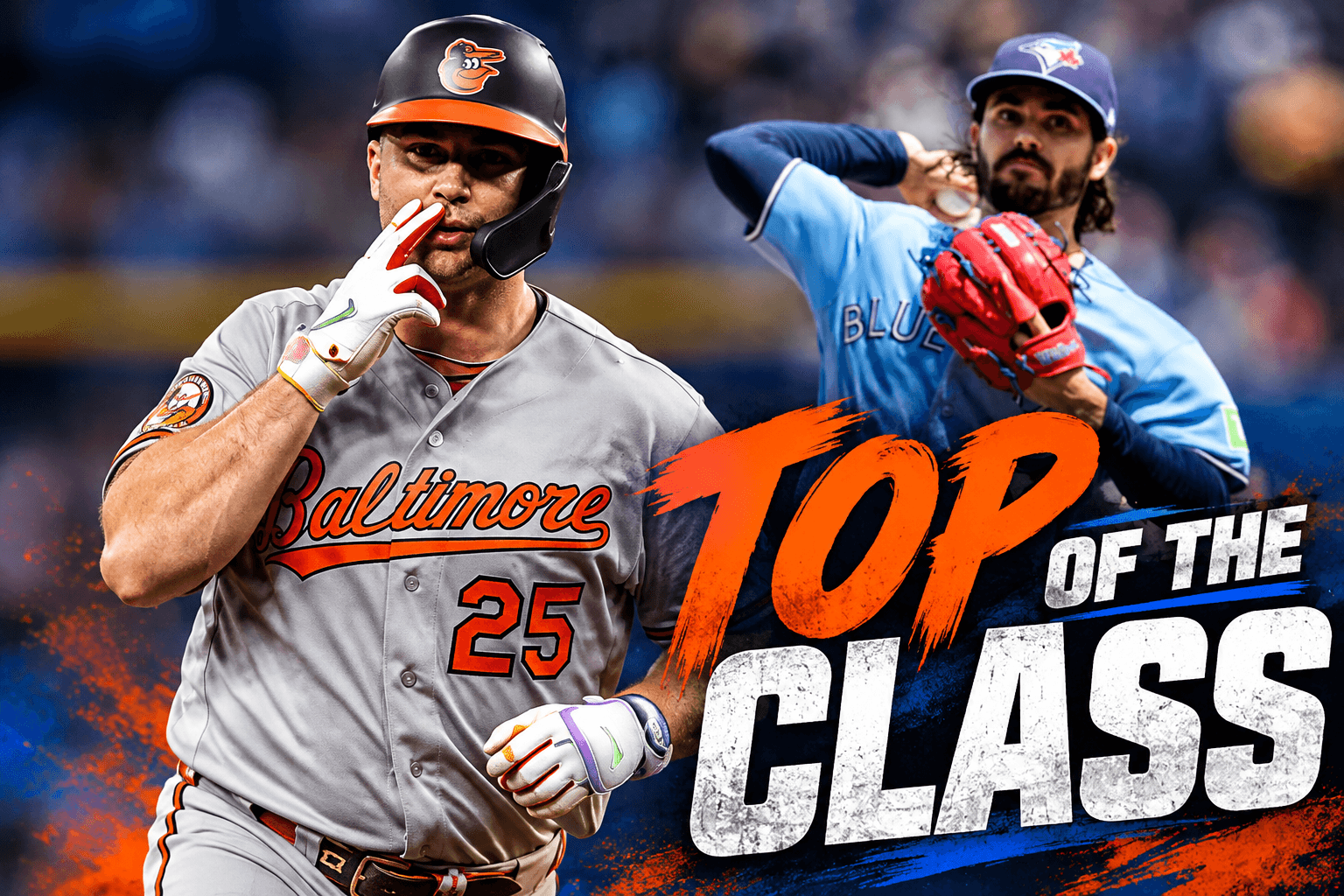
The Toronto Blue Jays and Baltimore Orioles have both been eliminated from postseason contention.
For two proud organizations that entered 2026 with legitimate expectations, the results are unquestionably disappointing. Their predicament though, definitely wasn’t the fault of their biggest free-agent acquisitions.
If anything, Dylan Cease and Pete Alonso provided perhaps the clearest evidence yet that in Major League Baseball, spending big on an individual star and building a winning baseball team are two separate entities.
When Cease signed with Toronto last December, the expectations were enormous. The Jays had just come within inches of a World Series championship, and Cease was brought in to help anchor what was supposed to be one of MLB’s deepest rotations.
Instead, he became unquestionably the staff's ace.
Dylan Cease Dominates In 2026
Cease finished his first season in Toronto with an 11-6 record, a 2.40 ERA and an American League-leading 239 strikeouts over 169 innings. He also became the first Blue Jays pitcher to record 200 strikeouts in six consecutive seasons.
While a late-season shoulder issue has ended his season a little prematurely, and he will have missed a few starts, there is little question that Cease has delivered one of the finest seasons of his career.
“I feel like I’ve executed well. Even in the games where I haven’t really had my best stuff or command, I’ve been able to mix well enough and get the job done.” — Dylan Cease
Unfortunately for Toronto, one dominant starting pitcher couldn’t compensate for an offence that struggled to produce consistently, combined with injuries to several impact players.
The Jays entered the season with +1400 odds to win the World Series, putting them among the teams with the shortest preseason championship prices.
Those expectations now seem a like a distant memory.
Alonso On Pace For Historic Career Totals
Baltimore presents an even more fascinating example.
Pete Alonso was one of the biggest names on the free-agent market after spending his entire career with the New York Mets. Rather than bringing back their longtime first baseman, New York allowed him to move on, and the Orioles signed Alonso to a five-year contract covering the 2026-30 seasons.
Alonso responded exactly as Baltimore hoped.
With two games remaining in the regular season, he is hitting .265 with 40 home runs and 108 RBI in 157 games. The 40 homers represent his fourth career 40-homer season, while his RBI total leads the American League.
His manager, Craig Albernaz, perhaps summed up Alonso’s contribution best.
“Hitting 40 home runs and having over 100 RBIs in this league is really impressive, and the consistency with which he does it, that doesn’t happen by accident.” — Craig Albernaz
Baltimore struggled through the bulk of the season, and was never truly within reach of the third, and final American League Wild Card spot.
The Orioles’ young core, once viewed as one of the most enviable collections of talent in baseball, failed to produce enough collectively. At one point this season, Baltimore was batting just .238 as a team, illustrating just how much pressure was being placed on individual hitters to manufacture offence.
Alonso absolutely did his part, but the Orioles didn’t do enough around him.
Those Mets...
The New York Mets offer the other side of that equation.
After deciding not to retain Alonso, New York struggled to replace his production at first base and endured a season that fell dramatically short of the expectations surrounding the club entering 2026. They failed to acknowledge that Alonso is indeed a superstar, and his absence left a void in the Mets lineup that just wasn't filled.
The Mets are a case in point, that replacing a superstar’s production is considerably easier on paper than it is on the field.
Then there's Kyle Tucker. The perennial All-Star outfielder was seen by most, as the prize of the free-agent class, signing a four-year, $240 million contract with the Los Angeles Dodgers. His first season in Los Angeles, however, has been far removed from the production that earned him that contract.
Entering the final week of the regular season, Tucker was hitting just .235 with 17 home runs, 70 RBI and a .725 OPS. For virtually any other player, those numbers would be slightly disappointing. For Tucker, they are rather shocking.
There is however, a considerable difference between struggling on a bad team and struggling on the defending back to back World Series champions. The Dodgers have already clinched another NL West title, and Tucker has finally started to heat up at just the right time. If he helps LA towards their pursuit of a three-peat, nobody in Dodger land will care too much about what his regular-season numbers looked like.
Boston Scores With Gray
Boston provides perhaps the most interesting counterargument. Ranger Suárez arrived with a five-year, $130 million contract and endured an uneven beginning to his first season with the Red Sox. They eventually found its footing, and Sonny Gray, another significant investment, has been spectacular. The veteran righthander, and former Vanderbilt star has established himself as one of the American League’s most effective starters, and his 18 victories now lead the league. At 18–5 with a 2.82 ERA, he has provided Boston with precisely the kind of frontline production the organization envisioned when it invested heavily in its rotation.
Suárez, meanwhile, has ultimately settled into Boston’s postseason rotation alongside Gray and Payton Tolle, giving the Red Sox exactly the kind of depth they envisioned when they spent heavily on pitching. Boston’s resurgence is important as it demonstrates what Toronto and Baltimore were unable to accomplish.
The Red Sox didn’t simply sign players they built around them, despite suffering season ending injuries to their projected stars, Garrett Crochet, and Roman Anthony. They went with what they had, and inserted a managerial change midseason, that completely altered the trajectory of the team, from the basement of the division, to a bona fide playoff team.
Lesson Learned?
Maybe that’s the larger lesson from the 2026 free-agent class. There is something intoxicating about free agency. A superstar walks into a press conference wearing a new uniform. A general manager announces a massive contract. Fans immediately begin imagining October baseball, and for good reason. Signing a major free agent is evidence that an organization is at least, trying, but trying and building are not necessarily the same thing.
The big name free-agent signing might be the headline, but it's the culture, and the system that wins in the end.
Sharp takes. Every morning.
Get the day's top stories, line moves, and exclusive analysis.
Join sharp bettors getting daily insights. Unsubscribe anytime.
BOOST US IN GOOGLE
★ Get more Cover takes in your Google Search